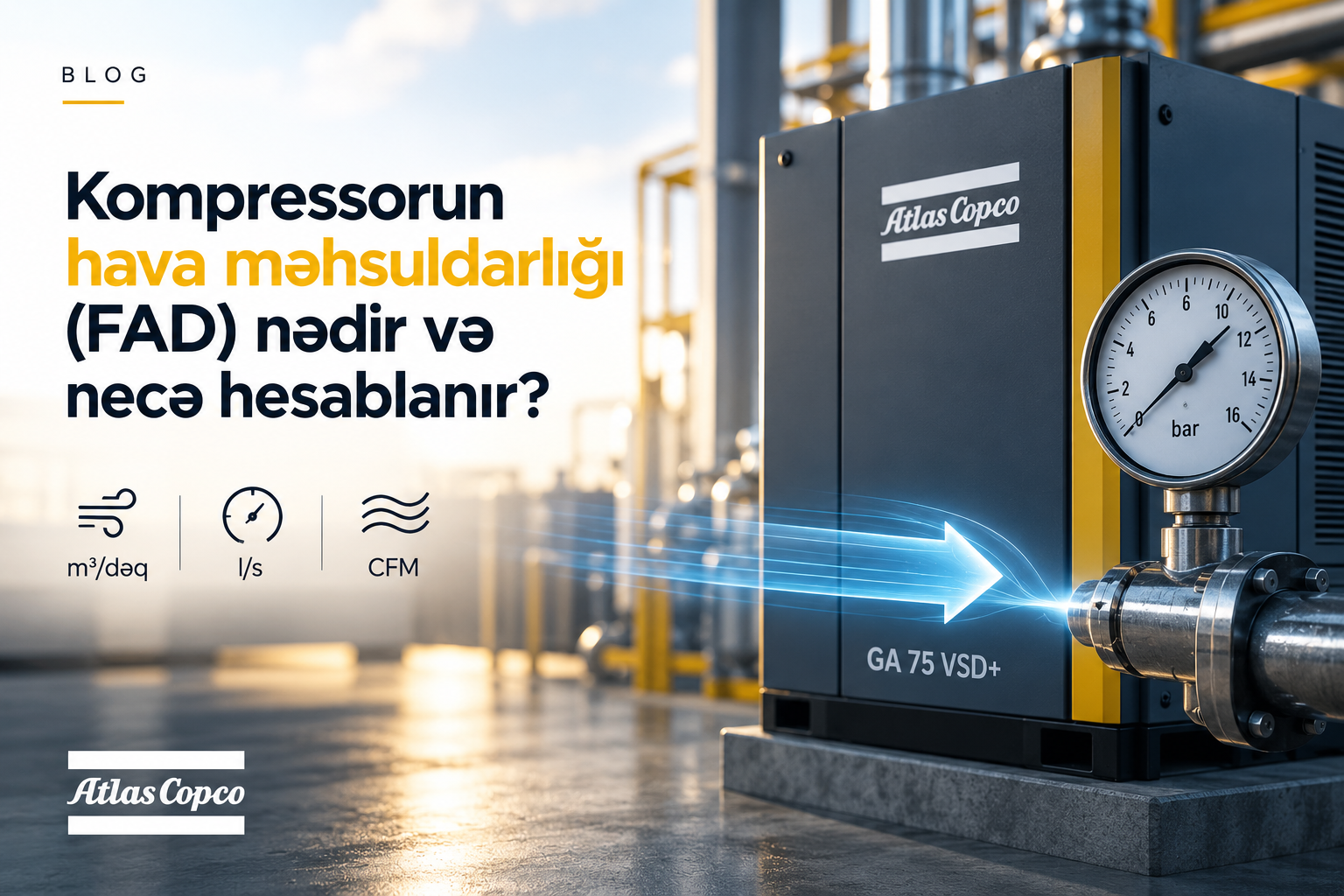

What is the air delivery rate (FAD) of a compressor?
When choosing a compressor for an industrial enterprise, one of the most important indicators to consider, along with engine power, operating pressure and energy consumption, is air delivery . In the technical specifications of compressors, this parameter is often called FAD (Free Air Delivery) .
FAD allows you to understand how much air a compressor can realistically provide under certain operating conditions and to select a compressor that meets the air needs of the facility.
What is FAD?
FAD – Free Air Delivery , can be expressed in Azerbaijani as free air delivery or compressor air efficiency.
Simply put, FAD is the volume of compressed air actually delivered from the compressor outlet, adjusted for the free air conditions at the compressor inlet.
The FAD indicator is used to compare the performance of different compressors and determine whether the compressor meets the air demand of pneumatic equipment.
The reference conditions in FAD indicators based on the ISO 1217 standard are usually as follows:
- inlet air temperature – 20°C
- absolute inlet pressure – 1 bar(a)
- relative humidity – 0%
This standardized approach allows for a more accurate comparison of the air performance of different compressor models.
What units is FAD expressed in?
The air capacity of a compressor can be expressed in various units of measurement. The most commonly used are:
- l/s – liter/second
- m³/min – cubic meter/minute
- m³/hour – cubic meter/hour
- CFM – cubic feet per minute
For example, if a compressor's FAD is listed as 10 m³/min , this means that the compressor provides an air flow equivalent to approximately 10 cubic meters of free air per minute.
When comparing units of measurement, it is important that they are converted to the same unit.
For example:
1 m³/min ≈ 16.67 l/s
So:
10 m³/min ≈ 166.7 l/s
How is FAD calculated?
Accurate determination of FAD is not limited to simply measuring the volume of air passing through the compressor outlet. Since the temperature and pressure of the air affect its density, the measured air flow is adjusted to certain reference conditions.
The simplified relationship used to convert normal airflow to FAD can be shown as:
qFAD = qN × ((273 + TFAD) / 273) × (pN / pFAD)
Here:
qFAD – free air delivery (FAD)
qN – air flow under normal conditions
TFAD – inlet air temperature, °C
pN – normal reference pressure
pFAD – absolute pressure at the compressor inlet
For example, if the normal air flow is 200 Nl/s , the inlet temperature is 30°C , and the inlet pressure is 1 bar(a) :
qFAD = 200 × ((273 + 30) / 273) × (1.013 / 1.00)
As a result, FAD is approximately:
225 l/h
organizes.
This example shows that when assessing airflow, it is necessary to pay attention not only to the nominal figure, but also to conditions such as temperature and pressure.
How is the FAD required for an enterprise determined?
The main goal when choosing a new compressor is to determine the total air demand of the equipment that will be used simultaneously in the facility.
Let's say there are three pneumatic pieces of equipment in the production area:
Equipment A – 100 l/s
Equipment B – 80 l/s
Equipment C – 70 l/s
If all three pieces of equipment are to operate simultaneously, the total air demand is:
100 + 80 + 70 = 250 l/s
will be.
However, selecting a compressor based solely on 250 l/s is not always the optimal approach. Future expansion of the system, changes in air demand, and other factors must be taken into account.
Atlas Copco's Compressed Air Manual suggests allowing approximately 10–20% for possible changes and future expansion when sizing the system .
For example, if we take a 15% reserve:
250 × 1.15 = 287.5 l/s
a suitable compressor solution that can provide a FAD of approximately 288 l/s or higher for the system can be considered.
The relationship between FAD and work pressure
When choosing a compressor, it is not enough to look at the FAD indicator alone. The air flow and the required working pressure must be evaluated together.
For example, if 7 bar is required to operate pneumatic equipment, the compressor must provide that air output within the pressure range required by the system.
Therefore, it is important to pay attention to the operating pressure at which the FAD indicator is given in the compressor's technical data.
As the operating pressure changes for the same compressor model, the available air output can also change. Therefore, when comparing two compressors, it is a better approach to look at the FAD figures they deliver at the same or required pressure , rather than just the maximum FAD figures.
Are FAD and engine power the same indicator?
No.
The motor power of a compressor is usually expressed in kW , and the air capacity is expressed in l/s, m³/min, m³/h, or CFM .
For example, even if two compressors have the same engine power, the FAD they provide may not be the same because their construction, compressor element, control system, and efficiency are different.
For this reason, the compressor selection should only be made:
“How many kW is it?”
It is not correct to base the question on
A more accurate approach is to determine the airflow and operating pressure required by the facility , and then select a compressor that effectively meets that demand.
What happens if FAD is not chosen correctly?
Failure of the compressor's air output to meet the actual needs of the enterprise can directly affect the production process and energy costs.
If FAD is lower than required:
- pressure drops may occur in the system;
- pneumatic equipment may not operate with the required performance;
- there may be interruptions in the production process;
- The compressor can operate at high load for a long time.
On the other hand, choosing a compressor that is too large for your needs is not an optimal solution. This can unnecessarily increase the initial investment and, in some cases, energy and operating costs.
Therefore, the goal is not to choose the largest compressor, but to choose a compressor system that meets current and future air demand.
Why is choosing the right compressor important?
The compressed air system is a key part of the production process in many industrial facilities. Proper sizing of the compressor helps maintain stable air pressure in the system, ensure efficient operation of pneumatic equipment, and optimize energy usage.
When choosing a compressor, the following indicators should be taken into account together:
- required FAD;
- working pressure;
- number of simultaneously operating equipment;
- changes in air demand throughout the day;
- pressure losses in the system;
- future production growth;
- the required quality of compressed air.
Atlas , we provide professional support in selecting Atlas Copco compressor solutions to meet your compressed air needs . You can determine the right compressor solution for your production process by considering the required air capacity and working pressure.